
For the last two quarters, the same conversation has repeated across portal engagements. A team has AI credits sitting unused in their HubSpot subscription. A rep is spending four hours a day on list-building and first-touch drafting. And the Prospecting Agent, which addresses both problems, sits unactivated because nobody trusts an AI to send email under the company's name.
The hesitation is rational. Untuned AI outreach reads like untuned AI outreach, and one bad send to a strategic account costs more than a quarter of manual prospecting saves. But the hesitation is also increasingly expensive, because the results from properly configured agent plays are no longer speculative. They are visible in portal dashboards.
One recent engagement produced numbers worth publishing. Not projections, not vendor benchmarks: actual outreach performance from a live portal running a Prospecting Agent play built around signal-led enrollment. What follows is the data, the mechanism behind it, and what changed in June that makes the setup available to every paid portal.
What is HubSpot's AI Prospecting Agent?
HubSpot's AI Prospecting Agent is a native tool that researches target companies, sources contacts, and drafts and sends personalized outreach without rep involvement, guided by a configured "play." A play defines the segment, the persona, the enrollment triggers, and the outreach strategy. The agent then handles research, drafting, sending, and follow-up sequencing on its own, with optional review-before-send controls for teams that want a human checkpoint.
HubSpot's own documentation frames the tool around trigger-driven targeting: identifying good-fit companies based on real-world events, then sourcing the right contacts at those companies. The distinction from sequences matters. A sequence sends a fixed cadence to a list a human built. The agent builds its own enrollment from signals, writes each email against live research on the account, and adapts follow-up based on engagement.
The agent exists to "identify good fit companies based on real-world triggers" and source the right contacts for outreach.
What results does the Prospecting Agent actually produce?
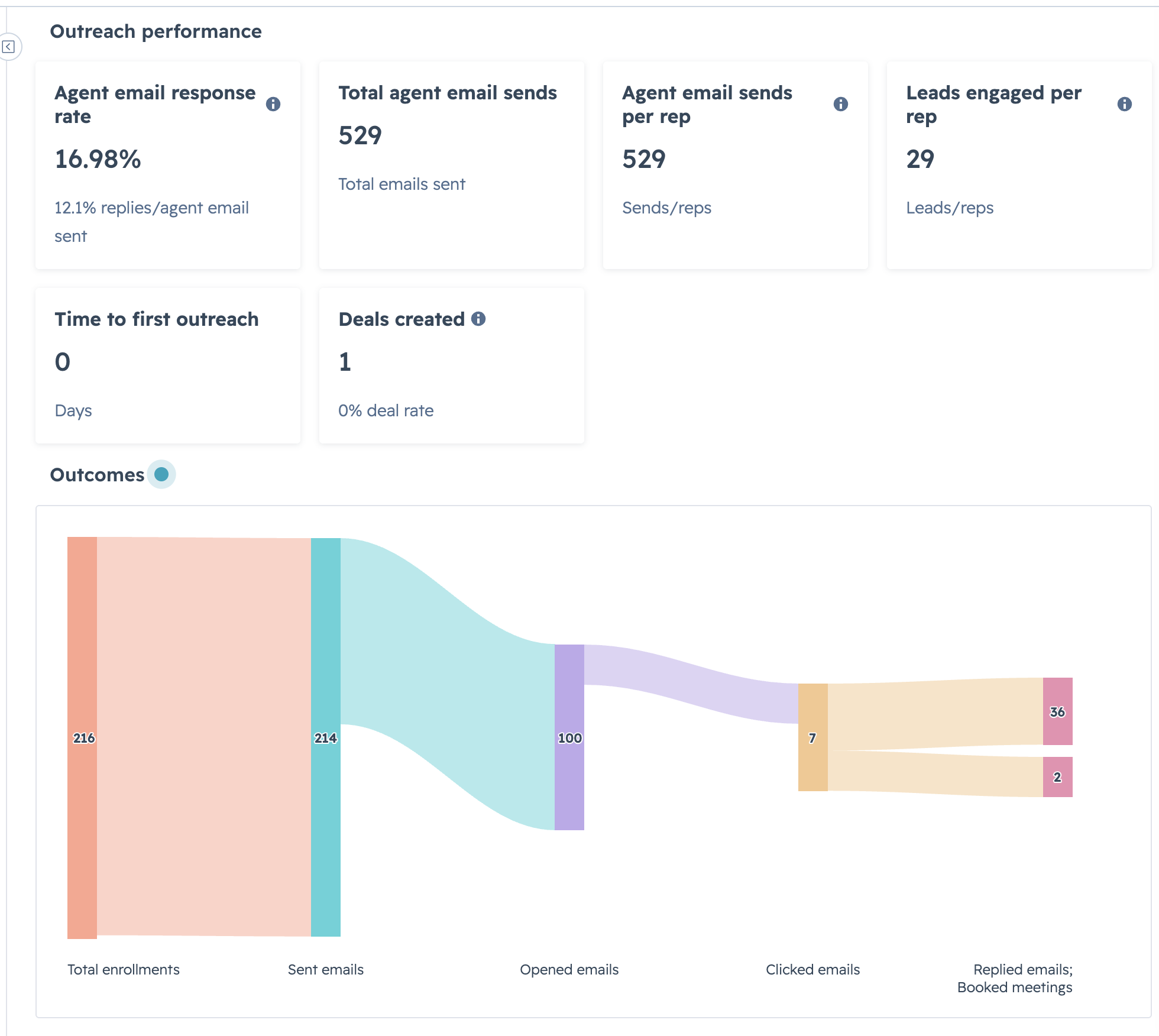
In a recent client engagement, a single Prospecting Agent play generated 529 AI-written emails to 216 enrolled leads and returned a 17 percent reply rate, 12 meeting requests, and 2 meetings booked with no manual work. The portal dashboard reported the response rate at 16.98 percent, with 29 leads engaged per rep and a time-to-first-outreach of zero days.
Three numbers in that set deserve individual attention.
17% reply rate
First, the reply rate. Not open rate. Reply rate. On cold outbound, most teams treat anything above 5 percent as a win, and industry-wide cold email reply rates typically sit in the low single digits. Seventeen percent is not an incremental improvement over that baseline. It is a different category of outcome.
Reply Quality
34% positive replies, asking for a meeting, next step, additional information
Second, the composition of the replies. Twelve of the replies were meeting requests. A third of everyone who responded asked to meet, asked how to meet, or asked to meet in person. That ratio is the signature of genuine personalization. Mail-merge tokens do not produce meeting requests at that rate; relevance does.
Meetings Booked
2 direct bookings
Third, the two meetings booked directly through the agent. No rep touched those threads until the calendar invite landed. The full loop, from enrollment to research to outreach to scheduling, ran without human intervention.
Why does a 17 percent reply rate matter on cold outbound?
A 17 percent reply rate on cold outbound signals that the recipient perceived the email as researched, relevant, and timed, which is precisely what signal-led enrollment is designed to produce. The number matters less as a vanity metric than as a diagnostic: it tells you the agent's targeting and personalization are doing real work.
The causal chain runs through enrollment quality. When a play enrolls contacts because a real-world trigger fired (a funding event, a leadership change, a competitive move), the outreach arrives inside a window where the recipient's context has actually shifted. The email is not interrupting; it is responding. That is the structural difference between signal-led prospecting and sequence blasting, and it is why the two approaches are about to diverge visibly in pipeline reviews.
The zero-days time-to-first-outreach metric reinforces the point. The agent contacts an account the moment it qualifies, not when a rep clears their backlog. Timing advantage compounds with relevance advantage.
What are Custom Signals, and what changed on June 30?
Custom Signals, launched June 30, 2026 inside HubSpot's Buyer Intent app, let you describe a buying moment in plain language while HubSpot's AI monitors the web for companies that match, returning every hit with cited sources. Before this release, buyer intent in HubSpot meant selecting from a fixed catalog of pre-built signals. Now the trigger vocabulary is open-ended: you write the description of the moment that matters to your business, and the agent watches for it.
The June update also expanded the pre-built catalog to 20 company news categories, spanning funding events, leadership changes, corporate restructuring, and competitive moves. The cited-sources requirement is the underrated piece. Every signal match arrives with a verifiable reference, which means a rep or an admin can audit why an account was enrolled before a single email leaves the portal.
For play architecture, this changes the design conversation. The question is no longer "which of HubSpot's signals apply to us" but "what does a buying moment look like in our market, stated in one sentence." A staffing firm can watch for facility expansions. A cybersecurity vendor can watch for CISO job postings. The signal definition becomes a strategy artifact, not a checkbox.
Who has access to the Prospecting Agent now?
Every paid HubSpot portal now has access to the Prospecting Agent, across all hubs and tiers, with usage drawing on the AI credits already included in paid subscriptions. HubSpot's June release removed the enterprise gate; the July knowledge base documentation lists eligible subscriptions across Sales, Marketing, Service, Content, Data, and Smart CRM tiers, with HubSpot Credits as the metering mechanism.
The practical implication: most teams reading this are already paying for the capability. The credits sit in the subscription whether or not a play is running. The cost of activation is configuration effort, not license expansion, and the configuration effort is measured in hours, not weeks.
Access is gated by permissions, not pricing. Setup requires Super Admin access or the specific Prospecting Agent permission, which gives RevOps a natural control point for rollout: pilot with one play, one segment, review-before-send enabled, then widen scope as the reply data comes in.
What this supersedes.
How do you set up a Prospecting Agent play that performs?
The implementation is mechanical once the targeting logic is clear. A performing play has four components, built in this order.
Persona and segment definition. One persona per play. The agent's personalization quality degrades when a single play spans conflicting personas, because the research prompts blur. Scope the segment tightly: firmographic filters plus at least one behavioral or signal-based qualifier.
Signal selection. Start with two or three signals from the 20-category catalog that map to genuine buying moments in your market, then add one Custom Signal written in plain language. Resist the urge to enroll on every signal; enrollment volume is not the goal, reply-worthy timing is.
Guardrails. Enable review-before-send for the first two weeks. Set frequency caps and maximum emails per enrollment. Confirm AI settings, connected inboxes, and credit controls before the first send. The 30-day adaptive enrollment default is sensible for most plays; shorten it for fast-moving segments.
Attribution wiring. Agent-sourced contacts do not follow the standard form-fill attribution path. Route them into a parallel attribution track with a custom property layer before they hit pipeline stage logic, or the results above become invisible in your revenue reporting. This is the same architectural gap covered in the previous Field Notes deep dive on attribution, and it applies from day one of activation.
Total setup time for a first play: half a day of focused configuration, assuming the portal's data hygiene is sound. The reply data starts arriving within the first enrollment window.
